Harmonious Hoi An, Vietnam

We took a plane from HaNoi to Danang in Central Vietnam and were met by our guide at the airport for the short drive south to the former trading port of Hoi An, located on the Thu Bon River. The region has been inhabited since the late iron age, over 2000+ years ago. Its more recent history was as a vibrant port with Arab, Chinese, Dutch, French, Japanese and Portuguese merchants throughout the 16th to 18th centuries. There is evidence of this presence in the historical buildings throughout the old town and dotted along the river. It is a UNESCO World Heritage site with more than 800 traditional houses  and buildings preserved.

Our stay in Hoi An was one of our favourites from this trip and both my daughter and I were glad we had chosen to spend 3 days/2 nights in this bustling town.  On arrival we stopped for lunch at Miss Ly cafe and enjoyed traditional vietnamese spring rolls, meat wonton and a cool water. The street was alive with a steady flow of bicycles and mopeds and we loved having a ringside seat.

The experience here was very different from Ha Noi, the old town is pedestrian and had a relaxed, breezy feel to it. After lunch, we ventured on a walking tour with our guide after the purchase of an Old Town admission ticket (120,000VD) from a booth at the end of the street. The addmission ticket allows you entry to all the historical buildings. The first stop was the beautiful Chua Ong Pagoda on Tran Phu Street, which was built in 1653 to honour the Chinese General, Quan Cong, who is venerated as a symbol of loyalty, integrity and justice. When visitors make offerings the custodian strikes a large bronze bowl.

From the pagoda it was a short walk to the Phuc Kien Assembly hall (open from 7am to 5.30pm). It is now the Jinshang Temple of Thien Hau, goddess of the sea and who protects sailors.  At the back of the temple is an altar which has seated figures which represent the Fujian families who fled China for Hoi An in the 1600’s.

It was lovely to walk the streets and look at the old buildings, and whilst it was very humid it was bearable. It was very picturesque, with something to catch the photographers eye with every few paces!

We visited an old  Vietnamese ancestral house, Tan Ky, which backs onto the river and has survived for 200 years and been home to a number of generations. There are influences from other cultures too, including some beautiful mother of pearl inlays of Chinese poetry formed as birds in flight.

Our final stop of the first day was the famous covered Japanese bridge, which arches beautifully across the Thu Bon river and was opened by Nguyen Phuc Chu Lord in 1719, who carved three Chinese symbols above the door in commemoration. Sculptures celebrating the Chinese year in which the Japanese emperors were born depict two dogs and two monkeys and also mark the year of the dog when the bridge building was commenced and the year of the monkey, when it was completed. The bridge provided the crossing to the Chinese quarter of Hoi An.

After our tour we took a river trip for an hour up the Thu Bon river. It was beautiful on the water, with a refreshing light breeze.  We passed old merchant houses set on stilts above the water or nestling on the banks of the river.

We watched some Vietnamese fishermen casting nets in the traditional way and they displayed their skills for us to photograph. We suspected that they wait until the tourist boats come and make their money though fishing for tourist dollars after their display! Fair enough I guess!

We retired to the beautifully named My Heart room at the Almanity Hotel, 326 Ly Thuong Kiet Street for dinner in the hotel restaurant and a good nights rest.

The following day, we were scheduled to take part in a cooking course at the Red Bridge Cooking School on the Thu Bon river. We were met by a representative of the school and proceeded to visit the local market to see for ourselves where fresh produce was bought. It was an assault on the senses with vibrant colours and rich, aromatic spices filling the air one minute, followed by the slightly less pleasant smells of fish, seafood and meat resting in the morning heat.  The hustle and bustle of locals and tourists going about their business meant the clamour of voices, laughter and the shouts of merchants vying for shoppers to buy their products.

Next we boarded a boat for the short trip to the Red Bridge Cooking School. Now, to say that both Lydia and I are challenged in the kitchen would be somewhat of an understatement! We were both a little concerned as to whether we would enjoy the class and if we would be a complete disaster compared to our fellow chefs!

The morning was fabulous, the chef patient and we were inspired.  We made Vietnamese spring rolls with our own hand made rice paper, a salad and traditional noodle soup.  Even better, we sat down with our fellow novice chefs to enjoy the fruits of our labours. The recipes are printed out for you so you can replicate the culinary delights on arrival at home. We would recommend this activity as great value at a cost of approx. $100 (booked in Australia before we travelled).

That evening we walked into the town from our hotel, had a fabulous dinner at the Green Mango restaurant and then strolled along the river enjoying the lights, music and thronging crowds. There were many children and elderly Vietnamese selling candles to float on the river for small amounts of Dong.  After being approached by many people in the course of the evening we were a little weary with this.

A very elderly woman approached us on a quiet stretch of river beyond the bridge where we were to all intents and purposes alone. I apologised and went to walk away at which point my 22 year old said “Mum did you see she was only wearing one shoe?”  I had not noticed,  but we had just spent our last Dong and, as we were leaving Vietnam the next day, I had no change.  I felt compelled to go to the ATM up the road, gave my daughter some cash and we went back to the elderly woman who was kneeling on the grass by the rivers edge. My daughter asked for a candle and then handed over what was to us, an insignificant amount of money but may have meant she did not have to work for the next week or month. The woman opened her hand and looked and then she held my daughters face between her two hands and said a blessing in Vietnamese, she was smiling and clearly happy but we walked away with tears, humbled and made to realise how fortunate we are and what a privileged life we lead. Those encounters are memorable and stay with you beyond your trip.

© Wanderers Dreams All content and photographs

Halcyon Hạ Long Bay

My daughter and I left the chaos of HaNoi early in the morning. Our driver collected us from the Apricot Hotel and we headed north for 4 hours towards the coastal town of HaLong. I found the outskirts of Hanoi fascinating, as we passed big city shopping malls juxtaposed with tall, skinny traditional homes in need of repair. Eventually the city gave way to rural scenes with paddy fields and the odd cow roaming free!

IMG_6000

We arrived at Halong Bay around midday and, after some refreshments at Tuan Chau pier we boarded our Paradise Luxury Cruise. Once the boat departed, all guests met in the dining room and we were served with a substantial buffet lunch which comprised traditional Vietnamese cuisine and was very enjoyable. At this stage people pretty much kept their own company but over the next couple of days, the thing I love most about travel,  friendships blossomed from shared experiences.

Ha Long Bay (Hạ Long meaning descending dragon)is situated in the northeast of Vietnam, along with the National Parks of Ba Be, Bai Tu Long and Lan Ha Bay. The Gulf of Tonkin has waters of emerald greens and turquoise blues and more then 2000 “islets” jut majestically from its surface, without a ripple. Undoubtedly, you will recognise Ha Long Bay even if you do not know the name, as it is a UNESCO World Heritage site famed for its outstanding natural beauty.

The islets are geological formations, karsts, of limestone and developed under the humid tropical weather of Vietnam. Limestone (calcium carbonate) dissolves relatively easily in slightly acidic water and the tropical rains have percolated through cracks in the limestone, widening and deepening the cracks over millions of years, until caves and internal lakes formed. There  are a number of cave systems and lakes within the island and the tops are dense jungle vegetation.

There were about 600 steps to the entrance to Hang Sung Sot (Surprise) cave. The views of the bay on the way up were magnificent which made the effort even more worthwhile. The cave has 3 vast chambers and a number of stalactites and stalagmites. The final chamber was beautifully lit which made it quite enchanting.

After leaving the cave we boarded the boat again and sailed to Ti Top Island where some of our group walked to the peak for the panoramic vistas, whilst the rest of us sat on the beach, sharedIMG_6077 stories and, watched some crazy German tourists take a cold plunge! We shared our boat with travellers from Canada, the US, Europe and Asia and I loved hearing their stories and learning about their journeys, some of which were quite emotional.

We returned to the boat for a cooking demonstration in Vietnamese cuisinIMG_6079e as we cruised the bay to our overnight anchorage at Ho Dang Tien.  We experienced local rice wine for the first and, probably the last, time! There was a well stocked bar and it was good to enjoy an evening cocktail. Dressing for dinner meant wearing traditional Bao Dai dress (provided) and official photos.

We travelled in early March and, with winter just ending, it was a chilly 18 degrees and shrouded in mist which added an ethereal feel to the stay.  In the mornings the sense of tranquility was wonderful and Tai Chi on the deck seemed a perfect start to the day.

The second day afforded time to kayak and explore the islets  at Bai Tu Long Bay  or swim to Thian Canh Son beach, however the water was extremely cold and kayaking was the preferred option for most of the guests. We witnessed some courageous tourists braving the chilly waters to swim but none from our boat!

Fishing Village at Vung Vieng

After lunch, we set sail to Vung Vieng and, at the pier, boarded traditional bamboo boats owned by the local people. It was so peaceful, just the sound of the punting pole breaking the surface and the boat moving through the water.

There are not many villagers left and the school house is reminiscent of days gone past as the children are  raised and attend schools in Ha Long town. The villagers farm fish which are caught off shore and then farmed in netted enclosures. There is a small “shop” and, as the takings go directly to the villagers, we bought some small souvenirs. There is also a pearl farm and show room which is really just aimed at tourists. The real pearl in my eyes was seeing a traditional way of life, very simple and focused on living and survival.


The next morning we left the boat very early on a promise to see some monkeys and a beautiful internal lake on one of the islands. Setting off on a bamboo boat we sailed through a small cave like entrance towards the light at the other end. Sure enough, sitting on a rock  like a sentry at the entrance to the internal lake was a monkey.  Exiting the cave we found ourselves on an internal lake open to the sky with a troupe of monkeys playing in the vegetation. It is always precious to see animals in their natural habitat so we were overjoyed at this encounter prior to leaving HaLong Bay.

On the drive back to Ha Noi I asked the driver to stop at the rice fields so I could take some photos. He was very happy to oblige and we walked among the paddy fields. Our guide took us to speak with an elderly lady working in one of the fields.  I loved the warmth of the greeting we received from her and, was amazed when she insisted that she have her photo taken with us!

Arriving back in HaNoi that evening, it seemed a world away from the tranquility of the three days we had spent in HaLong Bay.

Our two night cruise was with Paradise Cruises is approximately US$700 for two nights/three days in 2017.

© Wanderers Dreams All content and photographs


Hectic Ha Noi!

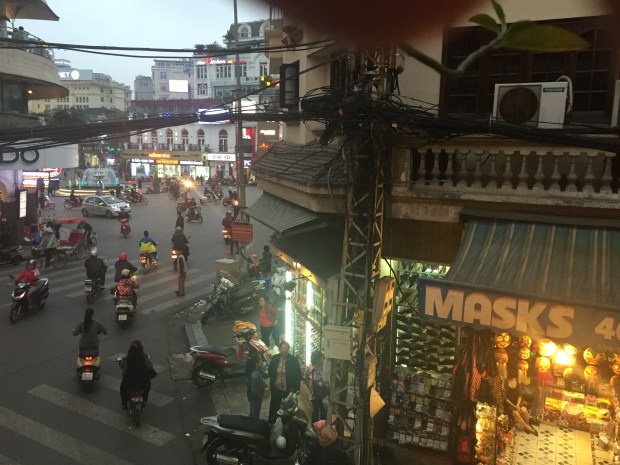
There is no way to arrive quietly in Ha Noi! The drive from the airport is a cacophony of sound and nothing prepares you for the seeming chaos on the roads. Motorbikes, scooters and bicycles seem to out number cars and, it is possible to carry anything by this mode of transport, including a cow on a trailer pulled by a tricycle!

As our time in Ha Noi is relatively short, our guide takes us to the Ho Chi Minh Mausoleum on the way to our hotel in the Old Quarter. Unfortunately, it is closed in the afternoons (open from 8-11am except Friday and Monday) but at least it is relatively quiet in the gardens. Often it is busy with many Vietnamese families coming to pay their respects to Ho Chi Minh, queuing to see his embalmed body in a glass sarcophagus. Photography is forbidden and it is important to dress respectfully (no shorts). The mausoleum itself was constructed in the early 1970’s and is centred in the botanical gardens.

The temple in the gardens is small but the altar is brimming with gifts to the deities.

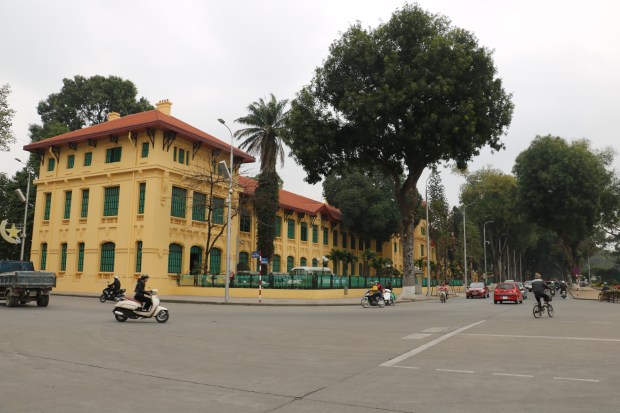
Leaving for our hotel, the roads around the Mausoleum provide beautiful examples of the French Colonial architecture, elegant buildings, often yellow in colour, set on tree-lined avenues. Many embassies are stated in this area.

IMG_5889

Arriving in Hoan Kiem District, the Old Quarter of Hoi An, it is more than just bustling or vibrant! Ha Noi can not fail to energise you once you have overcome your fear. Crossing the road is an art. At first it appears there are no rules, cars and scooters travel at steady speeds but come at you from all directions and, I mean every which way. The hotel concierge advised just step out and keep walking with purpose! Yikes!

You have to stand and watch for a while before having the courage to just do it. Taking our lives in our hands, my daughter and I step off the pavement and start to walk, our hearts pounding and expecting to end up in hospital. Amazingly enough there are rules and not running over pedestrians is one. As if by magic, the scooters part ways and zoom past either side of us and we make it safely to the pavement the other side of a 4 lane road, our ears reverberating with the sound of horns. One word of advice, once you step off the pavement try not to stop as it is very hard to decide when to move again as the riders don’t know what you are intending to do.

We are staying at the beautifully named Apricot Hotel, opposite the picturesque Hoan Kiem Lake and right in the centre of the Old District of Hoan Kiem.

The much venerated resident of the lake, a giant Swinhoe turtle, which signified the countries struggle for independence, unfortunately died just a few weeks before out visit. Tortoises are sacred in Vietnamese culture and the city mourned the loss of this turtle thought to be 100 years old.

Legend has it that Emperor Le Loi made a sword from a friends metal bar, which miraculously became imprinted with the words “Thuan Thien” meaning “harmonious with heaven”. The sword was used in battle but during a period of peace the king was visiting Thuy Quan Lake and a giant turtle rose out of the water asking for the sword to be returned to the “dragon king”. The king threw the sword into the lake and it was taken by the turtle below the surface to return it to its divine origins, from then on the lake became known as Hoan Kiem Lake or Lake of the Restored Sword.

From the hotel, we take a short walk to the Ngoc Son Temple past locals practising Tai Chi, entering the temple island by the Huc Bridge which literally means the “place touched by the morning sun”. The Ngoc Son Temple (Temple of the Jade Mountain) dates from the 18th century and sits on Jade Island and is dedicated to General Tran Hung Dao who defeated the army of Mongolian Emperor Kublai Khan in the 13th Century, the patron saint of physicians and Van Xuong, the scholar. We visited the pagoda which has a number of golden decorated altars dedicated to various deities and some antique artefacts.

We meet our guide at the hotel for a gourmet tour of Ha Noi. He promptly negotiates some cyclos and we are propelled by these fit cyclists through the warren of streets that make up Old Quarter. Each of the streets is named for the produce they sold from the shops and some vendors still sell the same wares such as Silk Street or Bamboo Street. Take time to look above street level and you will see some very old building frontages.

We sit on small plastic stools or chairs on the pavement, breathing in the wonderful aromas, listening to the sizzling woks amid the bustle of the streets and eating some terrific street food. Pork buns, meat skewers, noodles to die for and, a locally brewed beer at Bia Hoi. We stay into the evening when the locals start to arrive to pick up take outs on their scooters or to sit with their family and friends.

Later we find a backpackers bar above the street, on the corner of Pho Dinh Liet and Pho Hang Thung street, and enjoy a cold beer, ending our stay in Ha Noi pretty much the way we started, bemused by how the chaos just works!

IMG_0137

Accommodation:  Apricot Hotel

Travel Itinerary: I am blessed to have a Travel Manager whom I have been using for many years now. Michelle Michael-Peccora is a seasoned professional, who takes a pride in understanding the needs and experience her clients are looking for and Michelle will come to you. I booked this trip at very short notice and Michelle managed to create a memorable trip for us once again using Buffalo Tours. I call Michelle my travel therapist!

Michelle at Travel Managers

Buffalo Tours

© Wanderers Dreams All content and photographs