Secret…shhhh! As-Sifah Beach

Want to escape the bustle of Muscat – join locals for a picnic at the beautiful As-Sifah beach?

With typical Omani hospitality,  I was treated to an afternoon of rest and relaxation at As-Sifah beach by some local friends.

The long, pale sands of As-Sifah beach are just an hours drive south of Muscat along Route 1 and Yeti Street. The road meanders through the mountains before tumbling to the sea, and offers some spectacular scenery along the way. I was the fortunate passenger and spent the whole drive gazing out of the window in awe of the rugged terrain and, slightly nervous of the seemingly flimsy barriers and perilous car flight that awaited if my driving companion misjudged the road.

We stopped where possible so I could take photographs of the old Dhow resting on the sand of a wadi and capture some of the spectacular views along the route.

We eventually reached the old fishing village of As-Sifah and were greeted with friendly waves by locals before driving on to the beach. Living in Australia, I am privileged to have an abundance of amazing beaches to choose from and I can truthfully say that the beaches of Oman are in the same class.

IMG_6903

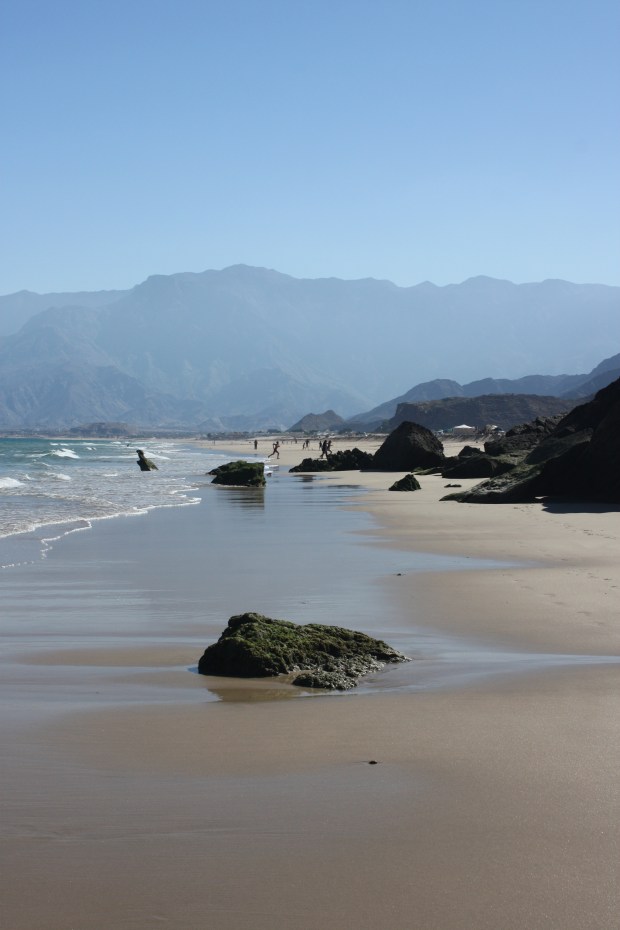
As-Sifah beach stretched out before me, I soaked up the magic cast by the silhouettes of mountains against a blue sky, which cascaded to the sands and crystal clear sea, a vista that never fails to still my heart.

Many families had already secured their place and delicious smells wafted through the air along with laughter and chatter. Whilst it was busy, we had no trouble finding a location for ourselves in relative solitude, where we could unwind, relax and savour our own Omani delights.

Map of As-Sifah

© Wanderers Dreams All content and photographs

Captivating Oman

The city of Muscat, in the Sultanate of Oman is just a one-hour flight from Dubai, and I’ve obtained my tourist visa on arrival.

At my city hotel I’m met punctually, by professional guide, Yousef Al-Jabri, from one of Oman’s most reputable tour companies. He’s impeccably turned out in traditional dress, and welcomes me warmly. I choose the passenger seat of his 4WD, to enjoy the amazing views and listen as Yousef teaches me about the culture of Oman, its openness and ability to combine tradition with freedom. His Majesty Sultan Qaboos, the highly respected Head of State, has instigated huge changes since the 1970s, building schools in every village, exchanging connecting desert tracks for sealed roads and creating infrastructure to encourage progress and growth.

I have long been excited about this visit to Oman and can quickly tell that my six night round trip won’t disappoint. First stop is the bustling fish market at As-Seeb, Oman has a long sea-faring history and fish is a diet staple.

From As-Seeb we venture 100 km north to the restored fort at Nakhal. Constructed in 1834 of mud and straw with palm frond ceilings, it’s built on the foundations of a pre-Islamic structure. I gaze from the watchtowers to the beautiful Hajar mountains nestled above the date palm farms, from which the fort derives its name.

We pass through these farms with their ancient Falaj irrigation, to the natural hot springs of Ath-Thowra (meaning ‘to boil’) where I dip my feet in the water, inviting the fish to give me a natural pedicure.

We take the 43 km drive over an unsealed road to Wadi Bani Auf and on to the dramatic, narrow, twisting Snake Gorge. It is a popular trekking route, but caution’s required during the rainy season as flash floods can prove fatal.

Stopping on the descent into Bilad Sayt, we photograph this picturesque,
old village with terraced fields and mud-baked houses, then park outside the village, amble through the streets, and enjoy the shade of the date palm terraces.

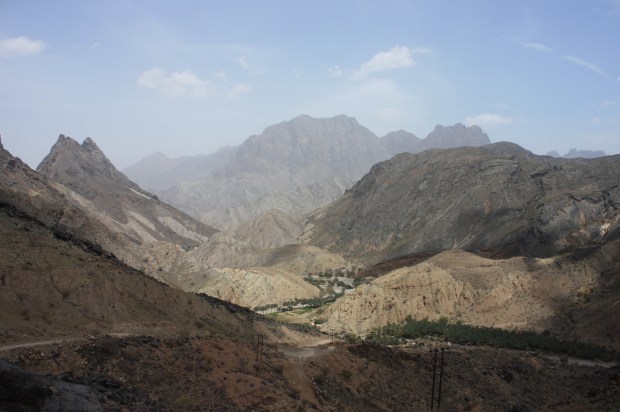
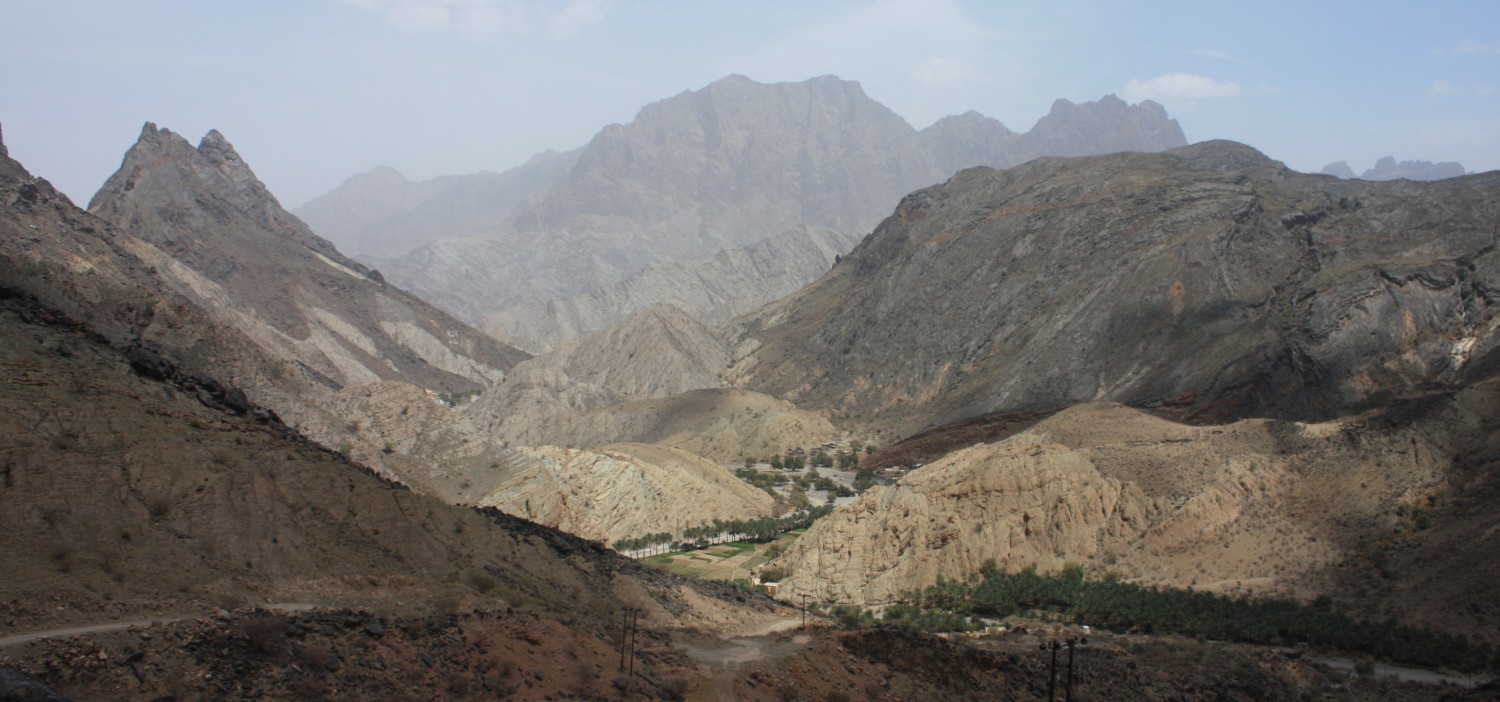
Leaving Bilad Sayt, we start to traverse the Hajar Mountains, a four hour, 70km drive that is truly spectacular. It is not often on my travels that I feel so completely overwhelmed with beauty and a spiritual sense of connection – emotions I hadn’t anticipated in Oman.
IMG_5795

Breathtakingly beautiful Hajar Mountains, Oman

The road from Bilad-Sayt is a winding ascent with a series of u-bends. Turning the last bend, the view quite literally takes my breath away. My ‘stop now, please’ request startles Yousef who thinks I’m suddenly taken ill. He relaxes when he realises that this mad English-Australian lady just wants to take a photo – although no photograph could capture this outstanding natural beauty.

We descend into Al-Hamra village at the foot of the Hajar Mountains, one of the oldest villages with well-preserved Yemeni-style mud-brick houses. In the small museum, Bayt Al-Safa, there’s a taste of life as women lived it.

I try my hand at pounding wheat to flour, observe women weaving traditional patterns using a loom, have my forehead painted with a sandalwood and saffron henna mix as the women would for weddings. After hhe tour, I enjoy the hospitality of the museum staff in their upper room majlis (sitting room) listening to other travellers’ tales and fortunate to hear the Arabic discussions of visiting village elders.

My overnight stay is a tent at The View, overlooking the town of Al-Hamra. The sounds of goat bells and a herdsman – such a pleasant alarm clock – wake me, it’s wet, windy and dusty but very peaceful and on a clear day the sunrise would compensate the early start.

After breakfast we take the road along Wadi Ghul, known in Oman as the Grand Canyon of Arabia, and head for Jebel Shams, Mountain of the Sun, at 3075 m, Oman’s highest mountain. Our 4WD copes well with the partly unsealed road, and there are barriers to help prevent accidental plunges down the 1000 m drops. The views from the summit are awesome and, gazing down into the canyon, I watch falcons catching the warm air currents looking for prey.

IMG_5867On the return journey, we stop at the village of Ghul and, armed with a plentiful water supply,
take a memorable short walk into the canyon
through the date palms and beautiful pink flowers of the Oleander.

From Ghul, it’s a short drive to BaHla, famous for its potteries and locally, for its legendary evil spirits, the Jinn. BaHla fort, a UNESCO World Heritage site dating from pre-Islaamic times, is being restored and has since been opened to the public.

By this stage, my appreciation of forts is on the wane, but it is completely restored by the beautifully preserved Jabrin Castle, undoubtedly my favourite. Constructed in 1675 by the Imam Bil-arab bin Sultan as a centre of learning, (astrology, medicine and Islaamic law) it offers great insights into the way of life in a bygone era. I am amazed at the skillfully carved doorposts and doors, painted ceilings and Arabic calligraphy, all of which speak of a rich artistic heritage.

There are excellent examples of falaj – primitive air conditioning, used also for pouring hot date honey onto ill-advised marauders – date stores and multiple majlis. Despite the heat, I climb the keep to gaze delightedly over the surrounding plains to the mountains.

We enjoy lunch in Nizwa, a large town about two hours from Muscat. It’s popular and ideally situated for exploring the area, so pre-booking a hotel is essential. Nizwa’s not always been hospitable to travellers, as famously described in Wilfred Theiseger’s Arabian Sands, when its conservative Iman threatened the author with imprisonment or death.

I briefly relish the wonderful views of the town from the round tower of 17th century Nizwa fort before spending the morning browsing the Souk for souvenirs, engaging with friendly locals tolerant of my simple Arabic.

Refreshed after a night in Nizwa, Jebel Akhdar, ‘the green mountain’, beckons. It is so called due to its climate, fruit orchards, and the gardens of roses for producing rosewater. The downward journey from the plateau is treacherous, and entry to the mountain road without the low gears of a 4WD is forbidden. In the foothills lies the ancient village of Birkat Al-Mawz, ‘pool of bananas’, though the plantations are now mainly dates as, according to Yousef, the bananas were wiped out by disease.

Leaving the mountain ranges for desert sands, we take the highway to Ibra and on to the Bedouin village of Bidiyyah, on the edge of Wahiba Sands. The village is a three hour drive from Muscat and half this from Nizwa.

I am spending two nights at the luxury, air conditioned Desert Night Camp just within the sands. Alternatively, choose the more authentic 1000 Nights Camp 19 km into the desert, with traditional Bedouin Goats hair tents and the luxury of a swimming pool. Both camps offer camel trekking, horse riding, dune driving, sand boarding and buggy driving, guided by local Bedouin who are extremely knowledgeable about the desert.

We visit an authentic Bedouin tent, politely remove our shoes and accept their famed hospitality, coffee with cardamom, tea and dates. The friendly women chat to us in a mix of Arabic and English, sharing a joke or two, enjoying the universal language of laughter.

I enjoy the peace and tranquility of a morning camel trek. The gracefulness of these “ships of the desert”, their easy sway and the only sound, their footsteps in the sand, transports me to another era. I am staggered by the agility of my Bedouin guide, who seamlessly transitions between precarious riding positions. He explains to me how the Bedouin would navigate across the desert, understanding the shifting sand landscape and using the sun, moon and stars as navigational aids.

Driving through the desert is a reminder of its scale and the outstanding beauty of this harsh environment. It captivates and enchants its visitors, whether with the romantic notion of Arabian nights and Scheherazade or the clear skies, shifting patterns of sand, and changing light from dawn to dusk.

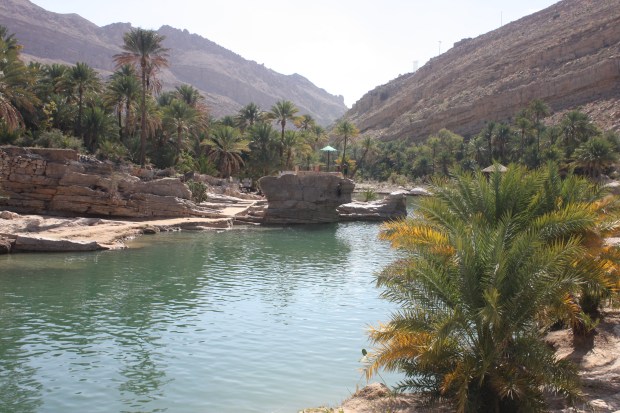
From the desert camp, we travel to Wadi Bani Khalid, a canyon with pretty date palm farms and small villages, famed for it’s natural beauty. Due to the natural spring in the mountains there’s a clear, blue pool of water all year round where people swim, enjoying the coolness. There’s a path along the canyon to Moqal Cave and a small cafe by the pool for refreshment on the way back.
IMG_8271

We continue our journey to Sur, a sea-faring town on the Gulf of Oman, where I enjoy watch the carpenters ply their centuries-old craft of building traditional dhows, and visit the small Maritime museum nearby.

In the evening, we drive an hour up the coast to Ras Al-Jinz, famous for its endangered green turtle nesting site. Booking is essential and escorted tours start at 9pm every evening. It’s possible to stay at the reserve and join a dawn tour to catch the last few departing turtles.

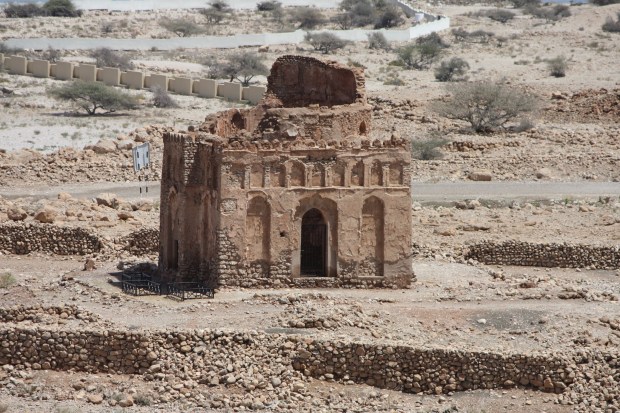
The end of my road trip is along the Sur-Qurayat coastal highway. We visit Bibi Miriam’s tomb at Qalhat, stop for a memorable swim at beautiful Fins Beach before proceeding to the Bimmah Sinkhole in Hawiyat Najm Park, enjoying the gatekeeper’s hospitality before returning to Muscat.
IMG_6088

Bibi Miriam’s tomb, Qalhat

The descent into Muscat reveals a city of white houses basking in the sunlight nestled between the mountains and the beautiful Indian Ocean, a befitting end to a captivating journey!

© Wanderers Dreams All content and photographs
Fifty-ish, Free & travelling in Jordan

Away with travel advisories and cautious friends, I’m in Amman, in the Hashemite Kingdom of Jordan, a vibrant city of battered and bruised cars, with Petra, first of seven cities on my six-day odyssey, firmly in my sights.

IMG_5488

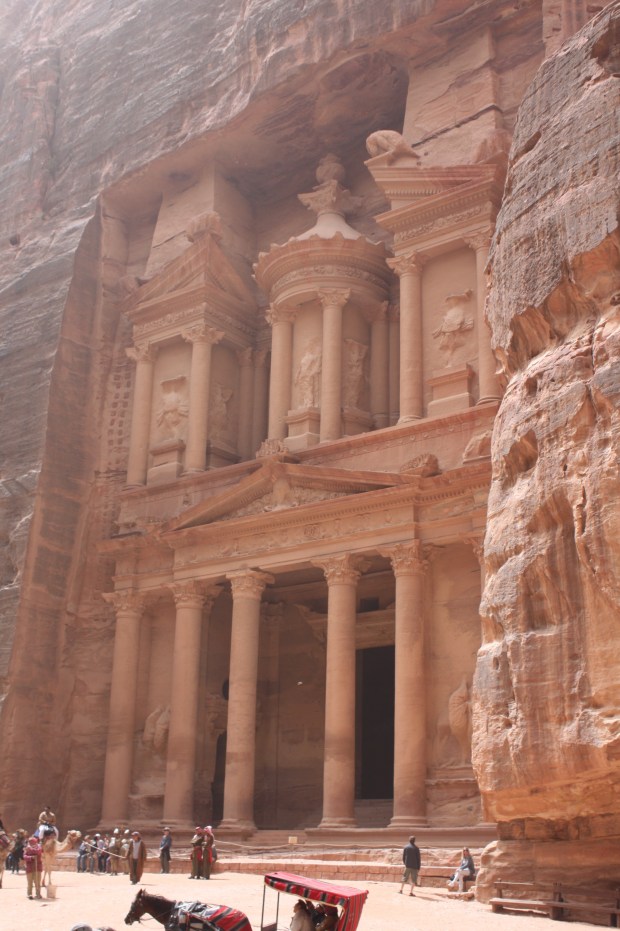
The Treasury

There’s just me, my tour company driver and 280 km to drive in his executive car with a ready supply of cold, bottled mineral water. A family man of middle years, courteous and professional, he is to be my constant daytime companion, waiting patiently while his guiding duties are relinquished to local experts along the route. His English is excellent, and my few words of Arabic go quite a way to cementing the friendship.

We drive along the ancient Kings Highway of biblical times, where families picnic happily, undeterred by the proximity of this busy road. Our first sightseeing stop is the ancient Moabite market town of Madaba, 29 km south-west of Amman. The town has strong Christian roots, dating back to 451AD, and today, is home to the largest population of Christians in Jordan. Dubbed ‘the city of mosaics’, it boasts numerous Byzantine and Umayyad mosaics. Most famed is the 6th century Madaba Mosaic Map, discovered in 1884, preserved in the floor of the Greek Orthodox Basilica of Saint George. Covering the area from the Nile Delta in Egypt to Palestine, it originally comprised two million pieces of coloured local stone, and depicts the major Biblical sites, including Bethelehem and Jericho. The eye is drawn to the earliest known detailed map of the Holy City of Jerusalem, complete with city walls, gates and the Church of the Holy Sepulchre. Other mosaics have been carefully restored at the Archeological Park (Hussein bin Ali St) and can be viewed in comparative solitude.

We continue our Biblical theme, with a 30-minute stop at Mount Nebo in Moab, believed to be the last resting place of Moses. The local guide is knowledgeable, engaging and thrills me with the stories of Joshua and Rahba, Lot, Sodom and Gomorrah. A dust haze restricts the view of the ancient cities of Jericho and Jerusalem, but I am moved by the knowledge that I am standing where this historical giant surveyed the Promised Land that he would never walk upon.

From Mt Nebo we continue our journey towards Petra, with an unscheduled stop at Qasr Shobak, where a Crusader castle (cAD1115) is gradually being restored. Admission is free and in this remote, hillside location, I’m the sole visitor, but I’m surprised to find the local caretaker/guide in the guard-house, and willingly engage his services. Local Bedouin inhabited the castle until the 1950-60s, when the government built them villages, with the foresight that these untouched ruins would one day attract tourists with a passion for archeology.

The last stop before Petra is Siq Al-Barid or Little Petra, as the name implies, a more compact version of its famous namesake. I walk with a Bedouin guide through the narrow canyon to find a temple and rooms carved into the rock, probably used as dining rooms for travellers.

Amazingly, there’s a preserved sample of a Nabataean painting. It’s possible to walk to Petra from here: a Bedouin guide can be arranged to allay safety and map-reading concerns, and the one day trek or overnight camp is reported to be well worth the effort.

After a refreshing night in a Petra hotel, I meet my local guide. Sameer  has extensive knowledge and a strong family history of guiding in Petra, adding significantly to my experience of this magnificent archeological and UNESCO World Heritage site.

Walking through the canyon-like Siq, I observe the ancient Nabataean carvings, from niches to place their gods, most importantly Dushara, to the man with a camel train. His head, like those of many carvings here, is thought to have been removed by later iconoclasts.

I am astounded by the ingenuity of this ancient people who developed the aflaj irrigation system, which captured, stored and channeled spring, rain or well water. They were perceptive enough to separate the channels for clean and dirty water.

It’s possible to take a horse and carriage through the Siq to the Al Khazneh, or Treasury but I feel you miss much in doing this, not least the spectacular view as you exit the narrow Siq into sunlight, to be greeted by the pink hue of this famous building, carved into the sandstone in the first century BC.

There is much speculation regarding the purpose of the Treasury, but my guide prefers the romantic option, that it was built to honour the king’s wife. Its popular name comes from the historic Bedouin myth that it was full of treasure, evidenced by shot marks on the urn from attempts to break it: protecting this treasure was one reason why Petra remained long undiscovered.

IMG_5504

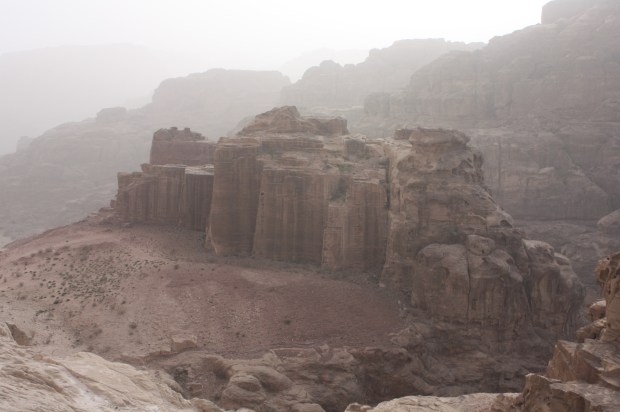
Tombs, Petra

As we walk, Sameer points out tombs of varying degrees of quality, evidenced by their positioning and quality of workmanship. He tells me that the amphitheatre beyond the tombs was built in a semi-circle so that all could hear equally and no seat would be in the glare of the sun. The Romans later added a stage and increased the seating to 3000. Around AD106, Petra was absorbed into the new Roman Province of Arabia.

At the Colonnades and temple Qasr al-Bint, I negotiate the hire of a mule for the 800-step climb to Al-Deir, the Monastery, a stopping place for the Nabataeans and traders on their journeys north. The mule-ride is not for the faint-hearted, but is preferable to walking on a very hot day: and you can then enjoy the view on the downward journey.

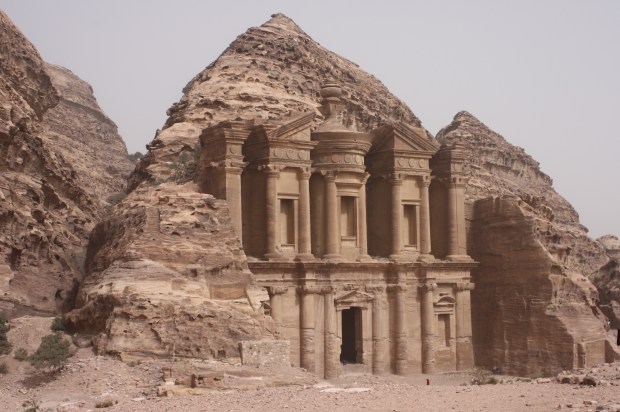
My reward is the magnificent Al-Deir bathed in sunlight, simpler in design than the Treasury and showing clear evidence of Roman architectural influence. The holes in the walls secured scaffolding while the stonemasons carved – for some a lifetime’s work.

IMG_5525

Al Deir

We walk beyond the monastery to gaze from the mountaintop at the surrounding vista, enjoying some solitude before the descent. At the base, rather than retrace our steps through Petra, my guide suggests a ride up the other side of the mountain. Once more, I find myself on a mule, among the happy Arabic chatter of a half-dozen Bedouin men, enjoying the most spectacular mountain views changing with the sunset hues – and yes, I feel safe, treated like a princess, a moment I will never forget.

IMG_5531

Leaving Petra, we drive to Wadi Rum, the desert made famous in the west by T E Lawrence, Lawrence of Arabia. I have a two-hour 4WD trip scheduled, but immediately wish it were longer.

With a local guide I start the drive from Wadi Rum village to the visitor centre, where the mountain peaks, Lawrence’s seven pillars of wisdom rise from the desert plain. I long to substitute the car for a camel trek, inspired by the magic of these ‘ships of the desert’ against the mountain backdrop. Instead, I enjoy hospitality in a Bedouin tent: tea (shay) or coffee (Qawa) with dates.

Next, Morad and I drive 188km to the Dead Sea and Bethany Beyond the Jordan, the site where Jesus was baptised by John the Baptist and recorded in many medieval and Byzantine texts. My emotions are stirred by its significance and the weight of history. Pottery, coins and architectural structures discovered over the years confirm the site was used early in the first century AD. It is believed that the nearby site of Tell Mar Elias is where Elijah was taken into heaven. With my electronic listening guide, I take the courtesy bus to the baptismal site and the river that borders Israel, where modern-day baptisms take place on both sides.

My final stop in Jordan takes me north of Amman to the city of Jerash
(Gerasa), truly one of the wonders of the world. It’s one of the best-preserved Graeco-Roman Decapolis cities, which stretch across modern Jordan, Syria, Israel and the Palestinian Territories. My archeologist guide had worked on the site for 30 years and told me they had still uncovered only 30% of the city.


I enter via the imposing Hadrian’s Arch, built to commemorate the visit of the Emperor in 129AD. It was an administrative, commercial and religious centre and I marvel at the amphitheatres, temples, churches and colonnaded streets: truly mind-blowing to imagine how many feet have trodden these roads throughout history

Sitting in the airport, I feel somewhat smug that I have ignored the naysayers regarding my visit to Jordan and I bask in the glow of the hospitality and history of this ancient land and its people.

© Wanderers Dreams All content and photographs